How to build a sales cadence with email, phone and WhatsApp
An operational guide to planning a multichannel sales cadence without turning prospecting into noise.
In this guide · 8 sections
A sales cadence is not an automated sequence of repeated attempts. It is a contact plan with a rationale, context and limits.
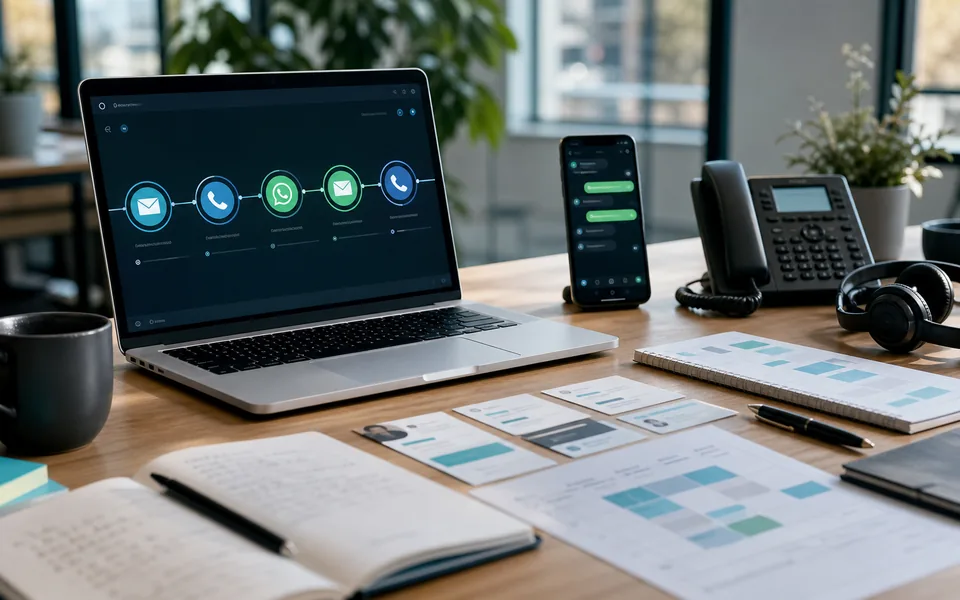
Email, phone and WhatsApp can work well together, provided each channel has a clear role. Email organises the message. Phone calls test urgency, timing and fit. WhatsApp can support conversations already under way or contacts for whom that channel is natural, but it should not be treated as a shortcut around a lack of relevance.
Before the cadence: qualify the list
The cadence starts before the first email. If the list is weak, the sequence will only scale the problem.
At a minimum, a list should answer five questions:
- Does the company belong to the right segment?
- Is it in the region or territory that matters?
- Is there a signal that justifies the approach?
- Is there at least one usable contact channel?
- Does the team know what it will propose in the first contact?
In the Commercial Explorer, this means avoiding generic lists and choosing useful segments: restaurants with incomplete websites, clinics in a specific area, training providers with an active digital presence or estate agencies that may need local partners. The guide to building a company list by city and sector shows how to organise that preparation.
Step 1: define the commercial objective
The first decision is what the cadence should produce. Not every cadence needs to try to book a meeting in the first contact.
Valid objectives:
- establish interest in an exploratory conversation;
- present a local partnership opportunity;
- invite someone to a demonstration;
- offer a quick assessment;
- re-engage old leads;
- engage contacts who downloaded a resource;
- open up a new sales region.
The objective changes the language. A post-download cadence should start from the topic of the download, not a generic company introduction.
Step 2: choose the reason for contact
The central question is: why is this company receiving this message now?
A good reason for contact can come from simple data: area, vertical, a sign of weak digital presence, a complementary fit with the current customer base, a resource download, an interaction with a product page or a sector where Makers has a clear solution.
Without a reason, the cadence depends on persuasive copy. With a reason, the approach becomes more concrete.
Step 3: assign each channel a role
Email is good for establishing context. It lets you explain the hypothesis in a few lines and make a clear request.
Phone calls are useful for discovering whether the timing is right, whether you have the right person and whether there is openness to a conversation. They should not repeat the email word for word.
WhatsApp should be used carefully. It is more personal, more immediate and more sensitive. It works best when there is an existing relationship, when the company already uses the channel publicly for customer service, or when the person has asked to continue there.
Step 4: build a 10-day cadence
A simple cadence can have five touchpoints over ten working days.
Day 0: opening email
The first email should have three parts: context, hypothesis and request. It should fit on a mobile phone screen.
Day 2: short call
The call should establish whether the hypothesis is worth a conversation. Start by identifying yourself, referring to the email you sent, explaining the reason for contact in one sentence and asking a qualifying question.
Day 4: email that adds value
The second email should not just say “I am following up”. It should add something useful: a checklist, short case, more specific question, Commercial Radar resource or sector-specific example.
Day 7: WhatsApp only where it makes sense
If there is a legitimate basis and the channel makes sense, the WhatsApp message should be short and transparent. If there is no response, do not turn the channel into a parallel sequence of pressure.
Day 10: polite close
The final touchpoint should close the cadence without drama and leave room for future re-engagement.
Step 5: record everything in the CRM
A cadence without records produces no learning. Each contact should leave a minimum trail: list source, segment, reason for contact, channel used, response, next action and reason for loss where applicable.
AOS can help structure the operation and connect data, tasks, automations and follow-up.
For example, if a contact replies asking for information on WhatsApp, record what they requested, who is responsible and the agreed next step. If the conversation passes to a team member, that person should receive the context and know which action is outstanding. The WhatsApp Agent can support the triage of incoming conversations and handover to a person, with rules defined for the operation.
Operational checklist
- The list has a clear segment, region and inclusion criterion.
- Each company has a recorded reason for contact.
- The first email fits on a mobile phone screen.
- The call has a qualifying question, not just a pitch.
- WhatsApp will only be used where it makes sense, and with care.
- There is a limit on attempts per contact.
- Each stage has a defined CRM status.
- The team knows when to stop.
- Negative responses will be classified.
- The outcome of the cadence will be reviewed weekly.
Conclusion
A good sales cadence does not come from automation. It comes from a well-built list, a clear hypothesis and a sequence of contacts that respects the recipient’s context.
Before increasing the number of contacts, improve the quality of the reason.
To prepare the written elements, see the subject line, opening line and CTA structure. Before including WhatsApp, review the situations where the channel makes sense and the cases to avoid.